

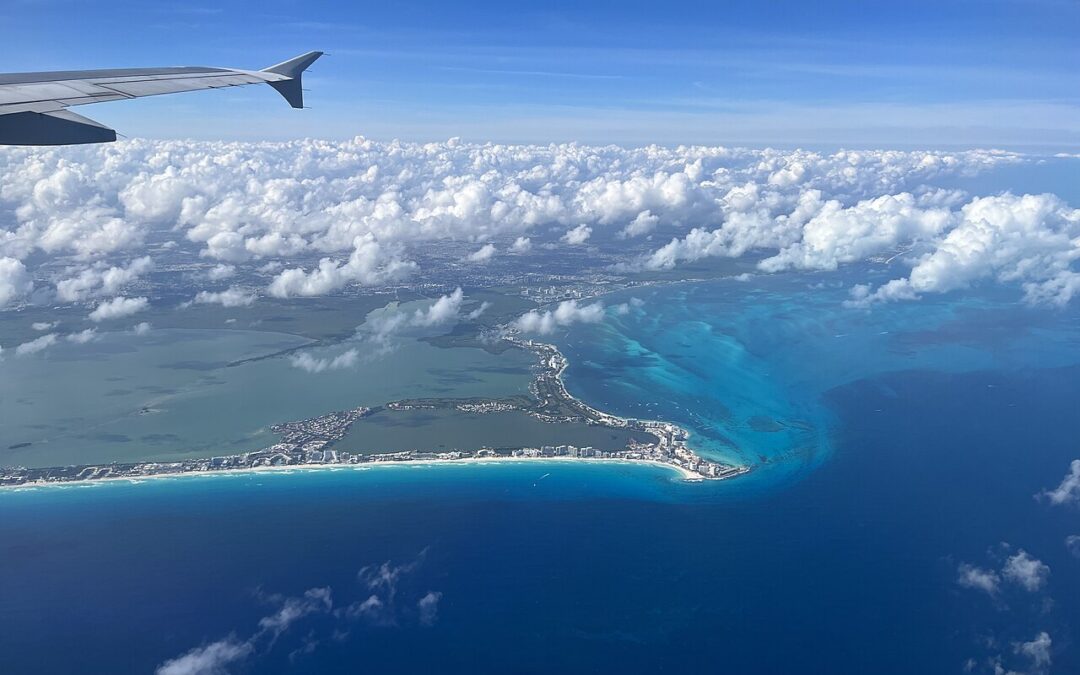
Photo: Antony-22 / Wikimedia Commons, CC BY-SA 4.0. Cancun coast, January 2024. Resized and cropped; this version uses the same license.
Cancun, Playa del Carmen and Tulum are one hour ahead of Chichén Itzá. If it is 9:00 a.m. at your hotel on the coast, it is 8:00 a.m. at the archaeological site. The Chichen Itza–Cancun time difference stays the same throughout the year under Mexico’s current rules.
The key is knowing which clock a pickup, guide meeting or ticket refers to. If your pickup is already confirmed in your hotel’s local time, follow that time without subtracting an hour.
Featured image: Cancun’s coast, photographed from an airplane in January 2024. Photo: Antony-22, Wikimedia Commons, CC BY-SA 4.0. Reduced-resolution version; the featured display is cropped. Image shared under CC BY-SA 4.0.
The two time zones on your Chichén Itzá trip
Cancun, Playa del Carmen and Tulum are in Quintana Roo. Chichén Itzá and Valladolid are in neighboring Yucatán. The states use different official time zones:
| Place | Local time zone |
|---|---|
| Cancun, Playa del Carmen and Tulum | Quintana Roo: UTC−5, Mexico’s Zona Sureste |
| Chichén Itzá and Valladolid | Yucatán: UTC−6, Mexico’s Zona Centro |
Mexico’s National Metrology Center, CENAM, lists the official zones. The federal time-zone law limits seasonal clock changes to specified northern border areas. Neither Quintana Roo nor Yucatán changes clocks for daylight saving time under the current rules.
For a quick conversion, subtract one hour from coastal time to get Chichén Itzá time. Add one hour when converting from Chichén Itzá to the coast. These conversions compare the same moment; they do not tell you how long the journey takes.
Keep your confirmed hotel pickup on the hotel’s clock
Use the written pickup instructions for your booking. A general departure time on a tour page may not apply to your hotel, rental or meeting point.
Record the date, named time zone and exact meeting place together. “Hotel lobby” may need clarification if your resort has several entrances.
Hypothetical example: if your operator confirms “7:00 a.m., Cancun local time, at your hotel’s main lobby,” be there at 7:00 a.m. It is then 6:00 a.m. at Chichén Itzá, but that does not change your pickup. This is an explanation of the clocks, not a Nah Experience departure time.
If a message gives only an hour or says “local time,” ask which location it means. If two messages disagree, have the operator resolve the discrepancy rather than converting one yourself.
A guide meeting, ticket time and pickup are separate appointments
Once you are in Yucatán, establish which clock the group is using for its next meeting. This matters when you split up for free time in Valladolid: keep the agreed time and meeting point together.
If you travel independently to meet a guide at Chichén Itzá, agree on the entrance or landmark and specify Yucatán local time. For illustration, 9:00 a.m. Chichén Itzá local time is the same moment as 10:00 a.m. Cancun local time. This is a conversion example, not a recommended arrival time.
Read a ticket or voucher separately: does its time refer to admission, check-in, the tour start or transportation? Ask the issuer if the time zone is missing. A ticket and a pickup message may describe different appointments.
For an independent visit, check the official INAH listing for Chichén Itzá before departure. Distinguish opening and last-entry hours from your appointment, and allow time for parking, walking and check-in.
Check your phone and calendar before relying on them
Your phone, watch and vehicle display may not use the same time zone. CENAM has documented outdated device software after Mexico’s 2022 reform; do not assume how your own devices will behave.
Compare your displayed time and selected zone with CENAM. If your app supports them, keep labeled world clocks for Cancun and a Yucatán city such as Mérida, and check that they show the one-hour difference.
Inspect the time zone when adding your pickup to a calendar. Keep the operator’s instructions available offline to compare with the event display. After crossing into Yucatán, check again before setting a meeting alarm.
Ask for your return estimate in your hotel’s local time. Changing clock displays does not change the time spent traveling or create an extra hour for sightseeing.
Visiting from the U.S. around a clock change?
Your home clock can change while both Mexican destinations stay put. Most U.S. locations that observe daylight saving time return to standard time on November 1, 2026, according to NIST’s daylight saving time rules. Cancun and Chichén Itzá do not make that November change.
Use your travel date when comparing with a U.S. city. “The same time as back home” can stop being useful during your stay; keep your pickup tied to its confirmed local clock.
The question to send before your departure
You can ask your operator:
For my trip on [date], what is the pickup time and exact meeting place at [hotel]? Is that Cancun/Quintana Roo local time (UTC−5)? Does any separate guide meeting or ticket check-in use Yucatán time (UTC−6)?
For Nah Experience’s private Chichén Itzá tour with an English-speaking guide, send your travel date, accommodation and group details to confirm pickup and availability. Ask about any transfer supplement and keep the final pickup details with your booking.
Time-zone information checked October 14, 2026. The times used in examples are illustrative and do not replace your booking, ticket or guide’s confirmed instructions.