

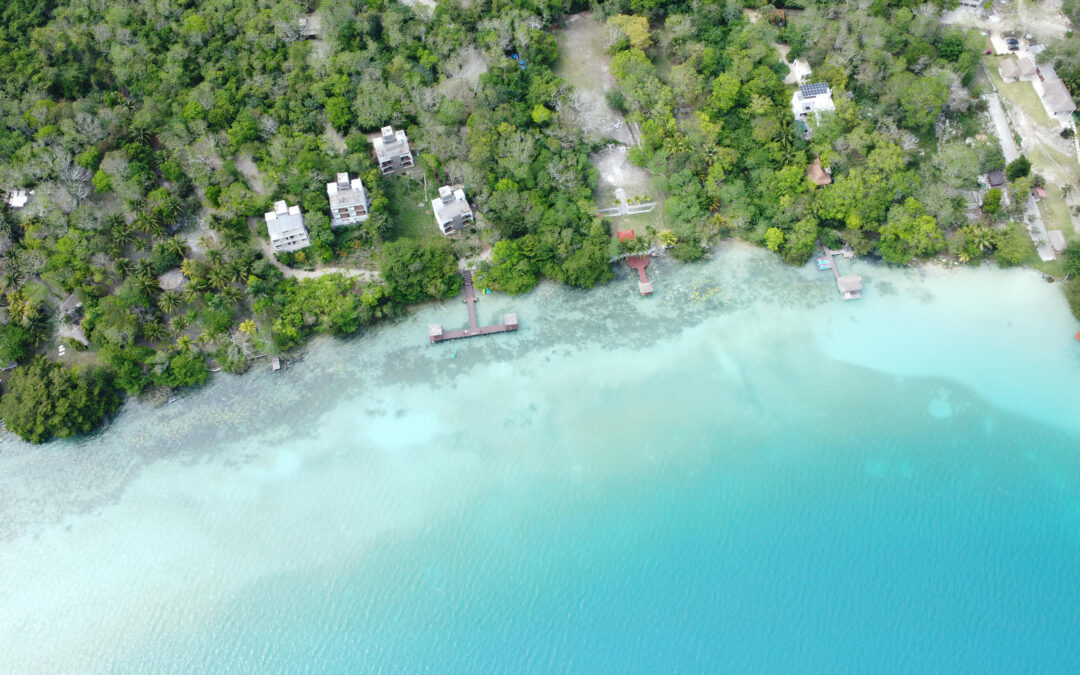
Photo: Yosef Ben Melamed / Wikimedia Commons, CC BY-SA 4.0. Bacalar Lagoon, April 2026. Resized and cropped; this version uses the same license.
Bacalar’s stromatolites may look like rocks, but their surfaces support living microbial communities. Enjoy them from a distance: they are not steps, seats or places to rest a kayak. Understanding that distinction is a useful part of planning a lagoon outing, especially if you expect to swim during your boat trip.
Bacalar is a freshwater destination. Its pale underwater formations belong to a different ecosystem from the coral reefs off Cozumel. This guide explains what you are looking at, how to keep your visit low-impact, and what to confirm when choosing a boat excursion.
Featured photograph: an aerial view of Bacalar Lagoon, not a close-up of stromatolites or a photograph of a Nah Experience departure. Photo by Yosef Ben Melamed, April 21, 2026, via Wikimedia Commons, CC BY-SA 4.0. Resized and cropped for display; this image version remains under CC BY-SA 4.0.
What are Bacalar’s stromatolites?
They are mineral structures built through the activity of communities of microorganisms. The UNAM Institute of Geology defines stromatolites by their layered structure. The broader term microbialites includes structures formed through microbial activity with different internal textures. You may encounter both words in explanations of Bacalar.
These are not individual animals and they are not simply piles of loose stones. A 2025 Ciencia UNAM report featuring researcher Luisa Falcón describes living bacteria at the surface and mineral deposits accumulating below. It also distinguishes the ancient fossil record of this kind of structure from the ages of formations in Bacalar, which range from decades to more than 9,000 years.
So a claim that you are seeing a “three-billion-year-old living rock” confuses two different things. The history of microbial structures on Earth is extraordinarily long; that does not give every formation in today’s lagoon the same age. You do not need an exact age to recognize that a living surface deserves care.
The local guidance: keep your distance
The Bacalar municipal ecology department’s visitor guide says to observe stromatolites from at least three meters away. It prohibits touching, standing or sitting on them, and anchoring or resting boats on them. Respect marked boundaries and any greater separation required at the location.
The same guide calls for respecting protected zones, avoiding contact with mangroves and leaving the local chivita snails in their habitat. A small craft does not make protected areas open for exploration.
Plan your swim before you leave the boat
Make the swimming briefing part of your visit. Before getting into the water, have the guide identify the entry point, the permitted swimming area and the route back aboard. If you are unsure what is below you, do not use a pale formation as a foothold while you work it out.
For a mixed group, settle different expectations early. Some travelers may want to swim; others may prefer to look and take photographs from the boat. Tell Nah Experience about those preferences before booking and confirm what the proposed boat and stops can accommodate. A lagoon photograph cannot establish water depth, easy boarding or a suitable experience for a non-swimmer.
Ask about the equipment provided and follow the captain’s instructions. If a stop changes, ask where the new swimming area begins rather than applying the previous stop’s briefing to a different location.
Pack for the lagoon’s product restrictions
The municipal ecology department advises against sunscreen entering the lagoon and against using its bottom sediment for skin exfoliation. A “biodegradable” or “reef-safe” label is not permission to ignore local instructions.
Build your packing around a sun shirt, a hat for the boat, a towel and a reusable water bottle. Check the current instructions for your actual stops before applying products. Keep a dry change of clothes separate from your swimwear so you can get comfortable afterward without unpacking everything on the boat. Our day-tour packing guide helps organize the rest of your bag.
Photograph the landscape without turning it into a prop
Start with the view available from the permitted position. A wide photograph can include the lagoon and shoreline without requiring a close approach to a formation. Use your camera’s zoom where useful, and keep your attention on the guide’s instructions while framing a shot.
For families, explain the difference between an ordinary-looking object and a permitted place to stand before anyone enters the water. “We look from here” is easier to follow than discovering a boundary after someone has crossed it. Leave space in the day for observing and listening, rather than making every stop a posed photograph.
Choose the excursion by its actual route
Do not assume that every Bacalar boat trip includes the same observation area, swimming stop or access to a named waterfront attraction. A general lagoon excursion is not automatically a specialist stromatolite tour. A private booking also does not override conservation boundaries.
Review Nah Experience’s private Bacalar tour, then use the contact option on the site to confirm the route, boat arrangement, English-speaking guidance and current operating conditions for your date. If learning about the lagoon’s ecology is your priority, mention it when requesting the itinerary. Specific observation stops must be confirmed rather than inferred from this guide.
Still deciding whether to travel from the Riviera Maya for the day? Our separate Bacalar day trip versus overnight guide focuses on the road journey and time available. This article is about how to approach the lagoon once you are there.
Plan a lagoon day that fits your group. Contact Nah Experience through the website with your travel date, accommodation and group size to discuss the available Bacalar itinerary and receive a confirmed quote in USD.
Sources and linked visitor guidance checked October 15, 2026. Follow current on-site restrictions and the instructions for your confirmed outing.