

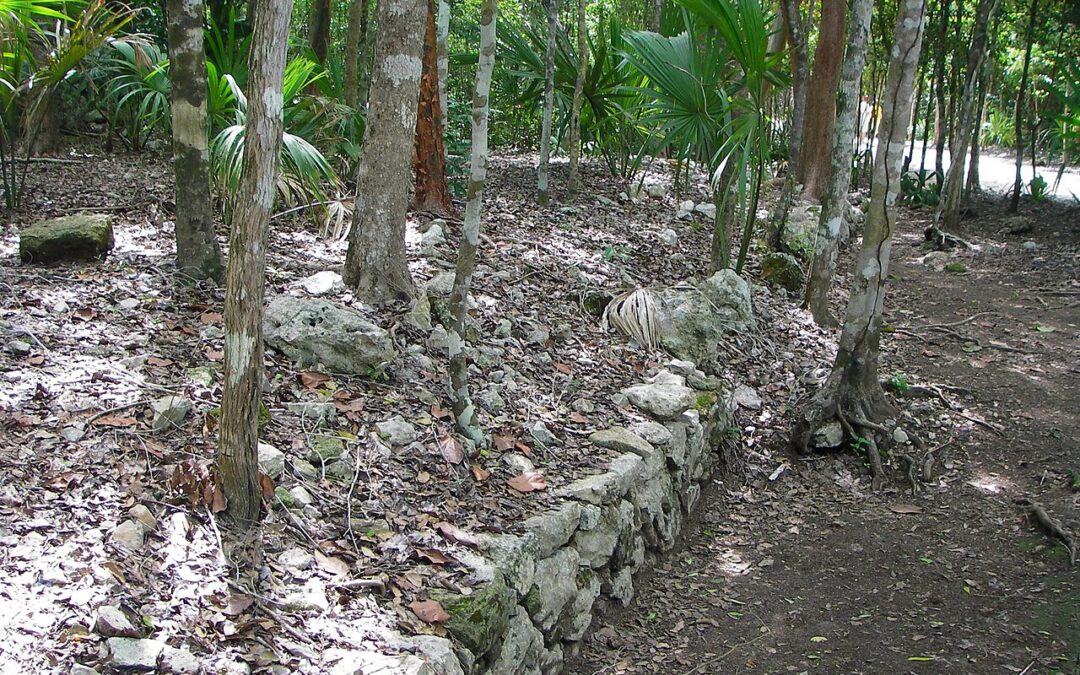
Photo: Keith Walbolt / Wikimedia Commons, CC BY 2.0. Cobá sacbé, July 2005. Historical photo, resized and cropped for display.
At Cobá, it is easy to give the buildings all your attention. Before your private tour, make room for a different subject: the roads between them. The Maya causeways known as sacbeob offer a way to understand how this city was built, how its separate architectural groups connected, and how far its ambitions reached.
You do not need to memorize a site plan to appreciate them. Take three questions with you: what was constructed here, what did it connect, and what can the evidence actually tell us? Those questions can turn a stretch between monuments into one of the most interesting parts of your visit.
1. Read the road as a built structure
A sacbé is a “white road”; sacbeob is the plural. INAH’s overview of Cobá describes raised stone roads of different lengths and widths. The important word for a visitor is raised. Think of a road as something people designed and assembled, with a profile and edges worth examining.
In her INAH essay on the labor behind Cobá, archaeologist María José Con Uribe explains that builders had to respond to uneven terrain and areas vulnerable to flooding. Some road sections were elevated considerably, while their surfaces were graded for runoff and finished with stucco. This brings the engineering into focus: moving through the landscape required careful work with the landscape.
Ask your guide to identify a visible construction feature along the permitted route. Can you distinguish an edge, a change in level, or the relationship between the road and the surrounding ground? Ask which parts are ancient remains and which reflect conservation or present-day visitor circulation. A shaded track or pale surface alone is not enough to identify an ancient causeway.
Keep your observations to the authorized paths. There is no need to climb an edge, move a stone, or step into vegetation to make sense of the construction. A clear explanation from a safe viewpoint is more useful than a close-up without context.
Featured image: Archive photograph of a sacbé at Cobá, July 2, 2005. Photo: Keith Walbolt, via Wikimedia Commons, CC BY 2.0. Photo resized for publication. This historical image does not establish current visitor access.
2. Follow the connections between architectural groups
The next question is about destinations. INAH describes Cobá’s road network as connecting ceremonial, administrative, and residential centers. Its detailed site guide notes that six causeways leave the Cobá Group and reach building groups of different sizes and importance. That is a useful starting point for seeing a connected city rather than a collection of individual monuments.
Choose one connection to discuss with your guide. Ask where the road leads, what is known about the buildings at either end, and how those places relate to one another. You can do this with a map and an explanation even when a destination is outside the day’s route.
Pay particular attention to the difference between identifying a feature and explaining its purpose. INAH places the unusual building known as Xaibé near the beginnings or ends of several causeways, while acknowledging that its actual function is unknown. A confident-sounding label can conceal an open archaeological question.
This is where a private conversation can be especially rewarding. If an explanation interests you, ask what supports it: a building’s arrangement, an inscription, excavated material, or a comparison with another site. You will leave with a better sense of how archaeological knowledge is made, as well as a clearer picture of Cobá.
3. Let the Cobá–Yaxuná road change the scale
One connection takes the story far beyond the visitor circuit. INAH identifies a causeway reaching Yaxuná, approximately 100 kilometers away, or about 62 miles. Hold that distance in mind when considering the amount of planning a regional road demands.
A study by Traci Ardren, Scott R. Hutson, Travis W. Stanton, Patrick Rohrer, and Justin P. Lowry, Sacbe 1 and Classic Maya Urban Culture, measures the Cobá–Yaxuná causeway at 99,072 meters. Its lidar analysis reveals numerous changes in direction, complicating the familiar picture of a nearly straight road.
The researchers argue that the causeway helped extend Cobá’s political influence and urban life westward. They suggest a possible role for the seventh-century ruler K’awiil Ajaw. The exact construction date remains uncertain, however, and her involvement should be presented as an interpretation rather than an established commission. Their evidence combines landscape survey, excavation, inscriptions, and lidar.
For your visit, ask what the road suggests about power: who could organize its construction, and what might its presence communicate? Keep those questions open. The regional connection gives you a wider frame for the city without adding an on-site checklist.
Make space for the roads in your private tour
Tell your guide before the visit that the sacbeob are a particular interest. A request such as “We would like to understand how the roads were built and how they connected the city” is more helpful than asking to cover every named causeway.
Then agree on what can be discussed within the available time and currently permitted route. A site map can help explain a distant connection; it does not establish that the whole route is open, maintained for visitors, or included in your tour. Treat the Cobá–Yaxuná connection as archaeological context unless a separate, appropriate visit has been specifically arranged.
For photographs, try pairing an overall view with one detail your guide has identified. Note the feature’s name and the explanation while they are fresh. Later, that small record will help distinguish what you actually saw from what you learned about the wider network.
Before leaving Cobá, return to your three questions. Can you describe one construction detail, explain one connection, and name one point that remains uncertain? That is a satisfying measure of an attentive visit.
Plan an archaeology-focused day with Nah Experience
Nah Experience’s Private Cobá & Punta Laguna Tour lists a dedicated English-speaking guide and private transportation. When inquiring, share your travel date, hotel, group size, and interest in Cobá’s roads. Ask how much time can be devoted to the archaeological visit and which route is currently available. Confirm the itinerary, inclusions, and total price in USD before booking.
Sources and the tour page were checked on October 12, 2026. This guide draws on published archaeology and INAH documentation.